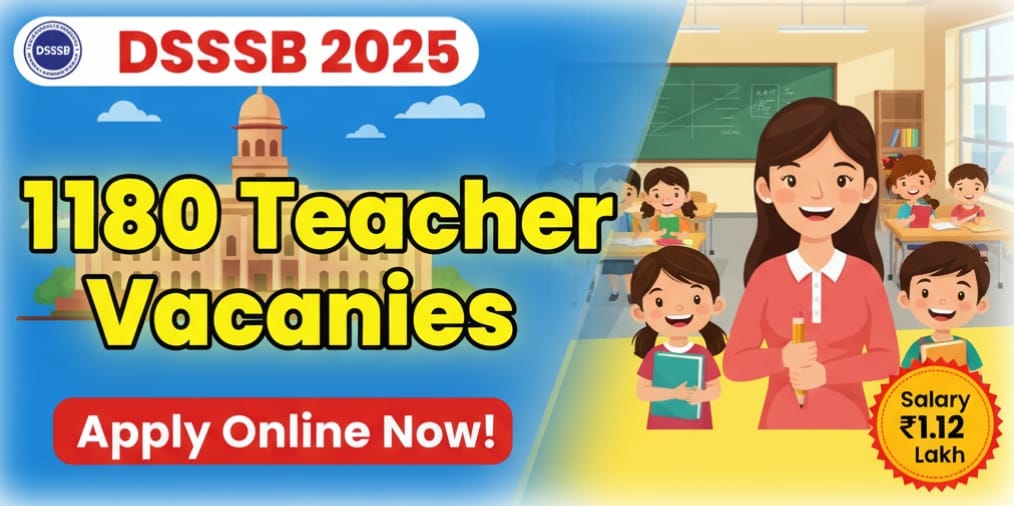
The Delhi Subordinate Services Selection Board (DSSSB) has officially released the notification for DSSSB Assistant Teacher (Primary) Recruitment 2025 under Advt. No. 05/2025. A total of 1180 vacancies have been announced across the Directorate of Education and New Delhi Municipal Council (NDMC).
This article covers eligibility, important dates, vacancy details, application process, fees, age limit, and selection process in detail.
Read more post
- RRB Group D Exam City and Admit Card 2025 – Out | Download Now
- Bihar BTSC Tutor Nursing Answer Key 2025 – Out for 498 Posts
- Bihar/UP Certificate Verification Online Form 2025-26 – Income Caste & Residence Certificate
- NABARD Assistant Manager Grade A Recruitment 2025 – Apply Online for 91 Posts
- PNB LBO Recruitment Online Form 2025 for 750 Post Apply Now
DSSSB Assistant Teacher (Primary) 2025 – Overview
| Particulars | Details |
|---|---|
| Recruitment Board | Delhi Subordinate Services Selection Board (DSSSB) |
| Advertisement No. | 05/2025 |
| Post Name | Assistant Teacher (Primary) |
| Total Vacancies | 1180 |
| Departments | Directorate of Education & New Delhi Municipal Council (NDMC) |
| Application Mode | Online |
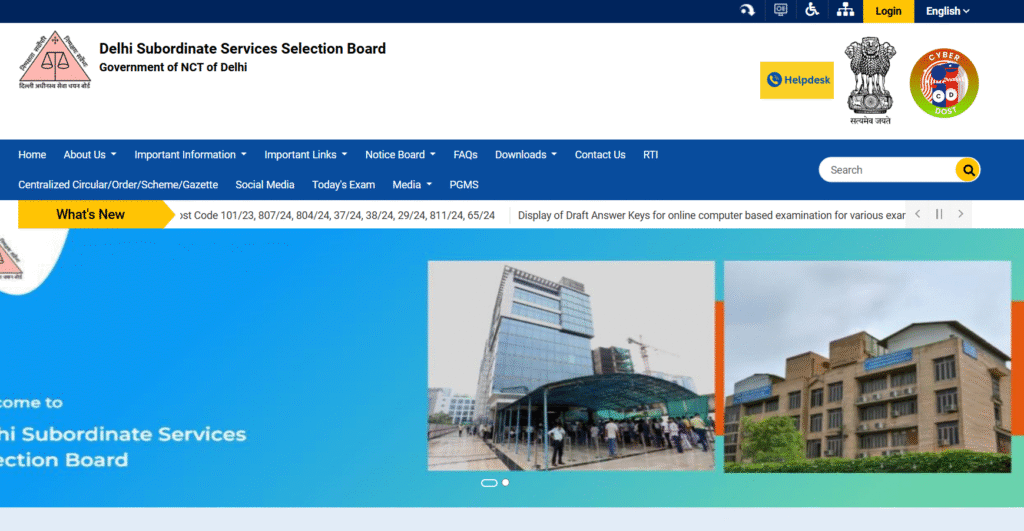
| Official Website | dsssb.delhi.gov.in |
| Pay Scale | ₹35,400 – ₹1,12,400 (Pay Level – 6) |
| Job Type | Group B (General Central Service, Non-Ministerial, Non-Gazetted) |
| Job Location | Delhi |
DSSSB Assistant Teacher (Primary) 2025 – Important Dates
| Event | Date |
|---|---|
| Notification Release | 10 September 2025 |
| Online Application Start Date | 17 September 2025 |
| Last Date to Apply Online | 16 October 2025 (11:00 PM) |
| Exam Date | To be Notified Later |
| Admit Card Release | To be Notified Later |
Important Links
| Apply online | Click Here ( Link active on 17-09-2025 ) |
| Download official notification | Click Here |
| Offical website | Click Here |
| Join Our Whatsapp Channel | Click Here |
DSSSB Assistant Teacher Vacancy 2025 – Post & Category-wise Distribution
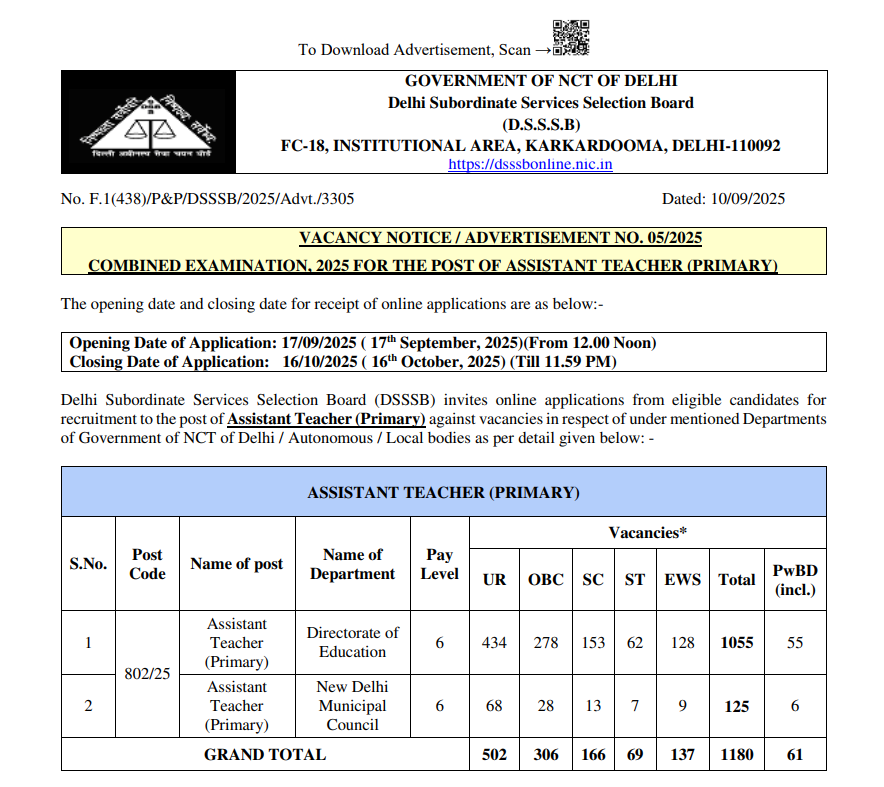
A total of 1180 vacancies have been released. Below is the detailed distribution:
| Department | UR | OBC | SC | ST | EWS | Total |
|---|---|---|---|---|---|---|
| Directorate of Education | 434 | 278 | 153 | 62 | 128 | 1055 |
| New Delhi Municipal Council (NDMC) | 68 | 28 | 13 | 7 | 9 | 125 |
| Grand Total | 502 | 306 | 166 | 69 | 137 | 1180 |
DSSSB Assistant Teacher (Primary) 2025 – Application Fee
| Category | Application Fee |
|---|---|
| General / OBC / EWS | ₹100 |
| SC / ST / PH / Women | Exempted |
| Payment Mode | Credit Card / Debit Card / Net Banking |
DSSSB Assistant Teacher (Primary) 2025 – Age Limit
- Maximum Age: 30 years (as on 01 January 2025)
- Age Relaxation: Applicable as per government rules for SC / ST / OBC / PH / Ex-Servicemen / Contract Teachers.
DSSSB Assistant Teacher 2025 – Educational Qualification
Candidates must possess one of the following qualifications:
- Senior Secondary (12th Class) with at least 50% marks and a 2-year Diploma in Elementary Education (D.El.Ed.).
- Senior Secondary with at least 45% marks and a 2-year Diploma in Elementary Education (as per NCTE regulations, 2002).
- Senior Secondary with at least 50% marks and a 4-year Bachelor of Elementary Education (B.El.Ed.).
- Senior Secondary with at least 50% marks and a 2-year Diploma in Education (Special Education).
- Graduation with a 2-year Diploma in Elementary Education.
Other Requirements:
- Must have passed Central Teacher Eligibility Test (CTET – Primary Level).
- Must have studied Hindi, Urdu, Punjabi, or English at the Secondary level.
Relaxations:
- 5% relaxation in marks for SC / ST / OBC / PH categories.
- One-time age relaxation for Contract / Guest Teachers.
DSSSB Assistant Teacher 2025 – Selection Process
Selection will be made on the basis of:
- Written Examination (Tier-I)
- Objective Type Questions (MCQs)
- Subjects may include: General Awareness, General Intelligence & Reasoning, Numerical Ability, Teaching Aptitude, Hindi & English Language, and Pedagogy.
- Negative Marking: 0.25 mark deduction per wrong answer.
- Skill Test / Document Verification (if required).
- Final Merit List will be prepared based on marks obtained in the written exam.
DSSSB Assistant Teacher (Primary) 2025 – Pay Scale
- Pay Band: ₹35,400 – ₹1,12,400 (Pay Level – 6)
- Job Type: Group B (General Central Service, Non-Ministerial, Non-Gazetted)
- Additional Benefits: DA, HRA, TA, Pension, and other government allowances.
How to Apply for DSSSB Assistant Teacher Recruitment 2025
Follow these steps to apply online:
- Visit the official website: dsssb.delhi.gov.in.
- Click on the link “DSSSB Assistant Teacher (Primary) Recruitment 2025”.
- Register using your valid Email ID and Mobile Number.
- Fill in the online application form carefully.
- Upload required documents, photograph, and signature.
- Pay the application fee (if applicable).
- Submit the application and download the confirmation page for referenc
Preparation Tips for DSSSB Assistant Teacher 2025
- Revise CTET-level subjects (Pedagogy, Child Development, Teaching Aptitude).
- Focus on General Awareness related to Delhi Government schemes and policies.
- Practice Previous Year Question Papers and attempt Mock Tests.
- Improve Time Management skills for the computer-based test.
DSSSB Assistant Teacher (Primary) — Exam Pattern: Deep, step-by-step explanation
Below I’ll explain the official exam pattern in detail, then translate that into practical tactics you can use in preparation and on exam day. Wherever the pattern is an official rule I’ll cite the DSSSB notification; for pedagogy/topic guidance I’ll cite CTET/NCTE resources that DSSSB’s “Section-B” maps to.
1) Official structure — the hard facts (straight from the DSSSB notification)
- One-Tier (Technical/Teaching) Computer Based Exam.
- Duration: 2 hours (120 minutes).
- Total Questions: 200 MCQs (each MCQ = 1 mark).
- Total Marks: 200.
- Paper Sections:
- Section A (General Part) — 100 questions = 100 marks. This is made of five heads (20 Qs each):
- General Intelligence & Reasoning — 20 Qs
- General Awareness — 20 Qs
- Arithmetical & Numerical Ability — 20 Qs
- English Language & Comprehension — 20 Qs
- Hindi Language & Comprehension — 20 Qs
- Section B (Domain / Post-related) — 100 questions = 100 marks, based on NCTE curriculum / teaching methodology for primary teachers (pedagogy, child development, subject-specific methods etc.). DSSSB
- Section A (General Part) — 100 questions = 100 marks. This is made of five heads (20 Qs each):
- Language: Bilingual (Hindi & English) except language papers which appear in that language only. DSSSB
- Negative marking: 0.25 mark deducted for each wrong MCQ. DSSSB
- Minimum qualifying marks (only for domain/Section-B): DSSSB applies mandatory minimum qualifying marks in Section-B (domain subject) while no minimum is required in Section-A — but the combined score of Section-A + Section-B determines final merit list. Category-wise minimums (for Section-B) are: General/EWS = 40%, OBC (Delhi) = 35%, SC/ST/PwBD = 30%. (Ex-servicemen get 5% relaxation subject to minimum 30%). DSSSB+1
- Normalization / Answer-key process: DSSSB may normalize marks (if required) across shifts using its published formula; draft answer keys will be displayed and candidates can submit objections online.
2) What does Section-B (NCTE / Teaching Methodology) really cover?
DSSSB explicitly states Section-B will be MCQs based on the NCTE curriculum (including teaching methodology) for the post. That maps closely to topics tested in CTET/teacher-eligibility tests and NCTE teacher-education frameworks. Key topic groups you must master:
- Child Development & Educational Psychology
- Stages of development, cognitive development (Piaget/Vygotsky), individual differences, learning processes, motivation, attention, memory.
- Learning & Pedagogy
- Learning theories, teaching-learning methods, activity-based & play-based learning, classroom transaction strategies.
- Assessment & Evaluation
- Formative vs summative assessment, continuous & comprehensive evaluation (CCE), tools & techniques, question-paper design, remedial teaching.
- Curriculum & Lesson Planning
- Lesson plan components, unit planning, learning outcomes, Bloom’s taxonomy, integration of subjects.
- Language Pedagogy (how to teach languages at primary level)
- Reading comprehension strategies, language acquisition, emergent literacy, grammar teaching approaches.
- Mathematics & EVS Pedagogy (how to teach numeracy, environmental studies)
- Concept builders, activity ideas, concrete-to-abstract progression.
- Inclusive Education & Classroom Management
- Addressing diverse learners, special needs, classroom organization, teaching aids.
- Contemporary policies & frameworks — NEP/NCF ideas, foundational literacy & numeracy emphasis.
(These topic groups are consistent with CTET and NCTE teacher-education frameworks)
3) Time management — realistic per-question budget (do the exact math)
- Total time = 120 minutes.
- Total Qs = 200.
Calculate per-question time:
- 120 minutes = 120 × 60 = 7,200 seconds.
- 7,200 seconds ÷ 200 questions = 36 seconds per question.
So on average you have ~36 seconds/question. That is tight — you must plan to move fast and avoid overthinking. (Do longer work on complex Section-B items but compensate by racing through straightforward Section-A questions.)
4) Attempt strategy & sequencing (practical options)
Because Section-B has mandatory qualifying marks, your strategy must ensure you secure Section-B minimum while also scoring strong in Section-A.
Two common, effective approaches:
Option A — Balanced sweep (recommended for most):
- Quick pass Section-A (30–40 minutes) — answer all easy language, reasoning, arithmetic, GK items (these are generally quick). Aim for 60–80 marks here.
- Deep work on Section-B (70–80 minutes) — devote remaining time to pedagogy/domain questions; this is where qualifying thresholds matter. If you find very hard Section-B Qs, mark and move on, return if time remains.
- Final 5–10 minutes: review flagged answers, change only clear corrections.
Option B — Section-B first (if pedagogy is your strength):
- Start with Section-B to secure the domain cut-off; finish Section-A quickly. Good if you’re confident in NCTE/CTET content and weaker in quick GK/Reasoning.
Negative-marking rules (how to decide whether to guess):
- Penalty = 0.25 per wrong answer. Expected value of blind guessing among 4 options = (1/4×1) − (3/4×0.25) = 0.25 − 0.1875 = +0.0625, meaning purely random guessing yields small positive EV. But in practice, guess only when you can eliminate at least one option (i.e., probability of correct ≥ 1/3). If you can narrow to two choices, guessing is favorable.
5) Scoring examples — close, precise arithmetic
Example: you attempt 150 questions: 120 correct, 30 wrong.
- Correct marks = 120 × 1 = 120.
- Negative marks = 30 × 0.25 = 7.5.
- Net score = 120 − 7.5 = 112.5 / 200 → 56.25%.
(Arithmetic: 120 − (30×0.25) = 120 − 7.5 = 112.5). This shows how wrong attempts erode score — keep wrongs low.
6) Minimum qualifying in Section-B — why it matters
DSSSB applies minimum marks only on Section-B and then uses the combined marks to prepare merit lists. That means:
- Even if you score high in Section-A, failing to clear the Section-B minimum (category-wise) may make you ineligible. So practicing pedagogy + NCTE topics is not optional. DSSSB+1
Category thresholds (Section-B): General/EWS 40%, OBC (Delhi) 35%, SC/ST/PwBD 30%
7) Preparation checklist (practical resources & plan)
- Master Section-B (start here): Use CTET Paper-1 pedagogy resources (child development, pedagogy, inclusive education). Study NCTE teacher-education documents and the National Curriculum Framework / NEP summaries. Testbook+1
- Section-A practice: Reasoning puzzles, basic arithmetic (speed & accuracy), current affairs (focus on Delhi/state schemes + national education news), language comprehension exercises (short RCs, error spotting).
- Mock tests: Full-length timed mocks (200 Qs, 120 mins) — simulate actual conditions and practice time management. Use DSSSB style mocks from reputable test portals.
- Previous Year Papers: Solve DSSSB/CTET previous papers to learn question style.
- Revision routine: Daily short revision of pedagogy concepts, and 3–4 full mocks per week during the last month.
8) On exam day — practical tips
- Reach exam center early; carry ID and admit card.
- Do one quick scan of all 200 Qs in first 3–4 minutes to pick obvious solves.
- Mark doubt items and don’t waste time — return later.
- Avoid last-minute panics; use final 5 minutes to review only flagged answers
9) Official mechanics after the exam
- Draft answer keys will be released; you can raise objections online within stipulated time. Scores may be normalized across shifts; DSSSB will use its published normalization formula if needed. Final merit list is on combined marks (A+B).
DSSSB Assistant Teacher (Primary) Exam Pattern 2025 – FAQs
The DSSSB Assistant Teacher (Primary) Exam 2025 will be conducted in one-tier online mode with a total of 200 multiple-choice questions for 200 marks. The paper is divided into two sections:
- Section A (General Subjects) – 100 marks
- Section B (Teaching Methodology & Domain Knowledge) – 100 marks
There will be a negative marking of 0.25 marks for each wrong answer, and the total exam duration is 2 hours.
1. How many questions are asked in the exam?
A total of 200 questions are asked, each carrying one mark.
2. Which subjects are included in Section A?
Section A has 20 questions each from:
- General Intelligence & Reasoning
- General Awareness
- Arithmetical & Numerical Ability
- English Language & Comprehension
- Hindi Language & Comprehension
3. What topics are covered in Section B?
Section B focuses on teaching aptitude and pedagogy, covering:
- Child Development & Pedagogy
- Inclusive Education and Classroom Management
- Assessment and Evaluation
- Lesson Planning and Educational Psychology
- Teaching Methodology for Mathematics, EVS, and Languages
4. What is the marking scheme of the exam?
- Correct answer: +1 mark
- Wrong answer: −0.25 mark
- Unattempted: 0 mark
5. What are the minimum qualifying marks?
- General/EWS: 40%
- OBC (Delhi): 35%
- SC/ST/PwBD: 30%
6. What is the duration of the DSSSB Assistant Teacher exam?
The total duration of the exam is 120 minutes (2 hours).
7. In which languages is the exam available?
The exam is bilingual – Hindi and English. However, English section questions are only in English, and Hindi section questions are only in Hindi.
8. How is the merit list prepared?
The final merit list is prepared based on the combined scores of Section A and Section B. But candidates must qualify Section B separately to be considered.
9. Is normalization of marks applied?
Yes, if the exam is conducted in multiple shifts, DSSSB applies normalization of marks to ensure fairness.